
Knox Release Date Boundaries
A pretrial detainee usually has no sentence-based release date. The court may later enter a release, detention, dismissal, plea, or sentencing order, while the jail records the actual movement. Someone serving a county sentence may have a date shaped by the judgment, custody credit, other holds, and jail processing. Knox County publishes no local good-time formula or weekend-release rule.
An IDOC commitment is separate. The state offender record can display a Projected Parole Date and a later Projected Discharge Date. The first forecasts physical prison exit or transition to mandatory supervised release. The second forecasts the end of the broader sentence and supervision. Neither is an appointment or a guarantee.
Find Knox Projected Release Dates
Start with the source of custody. A Knox jail booking, an IDOC commitment, and federal detention use different records. Match the person with more than a name, and save the date on which any projection was viewed.
- Check the Knox case for the detention, sentence, time-served, probation, dismissal, or mittimus order.
- For county custody, call the jail and request its computation sheet and release ledger if a date is available.
- For an IDOC commitment, open the state offender search and match IDOC number, birth details, conviction county, offense, and status.
- Read Offender Status first, then Projected Parole Date, Last Paroled Date, and Projected Discharge Date.
- Verify the actual exit after the date through the updated status or official record.
The Knox County release-record path covers the sheriff and court sources when the state search does not apply.
Read Knox IDOC Release Fields
The IDOC offender search accepts a surname or name combination, IDOC number, or birth date. Partial names may return several people. Confirm stable details before using a date. Maintenance can interrupt the form; IDOC's public phone is 217-558-2200.
| IDOC field | How to read it |
|---|---|
| Offender Status | Present context within the state system |
| Admission Date | Start of the IDOC custody episode |
| Projected Parole Date | Forecast prison exit or MSR transition |
| Last Paroled Date | A prior exit to parole or MSR recorded by IDOC |
| Projected Discharge Date | Forecast end of the wider sentence or supervision |
| Sentence Discharged? | Completion status for an individual offense count |
One offense marked discharged does not prove that all counts or supervision ended. A Last Paroled Date can coexist with a current incarcerated status after revocation. Read the whole record.
The IDOC FAQ explains that information stops displaying after sentence completion.
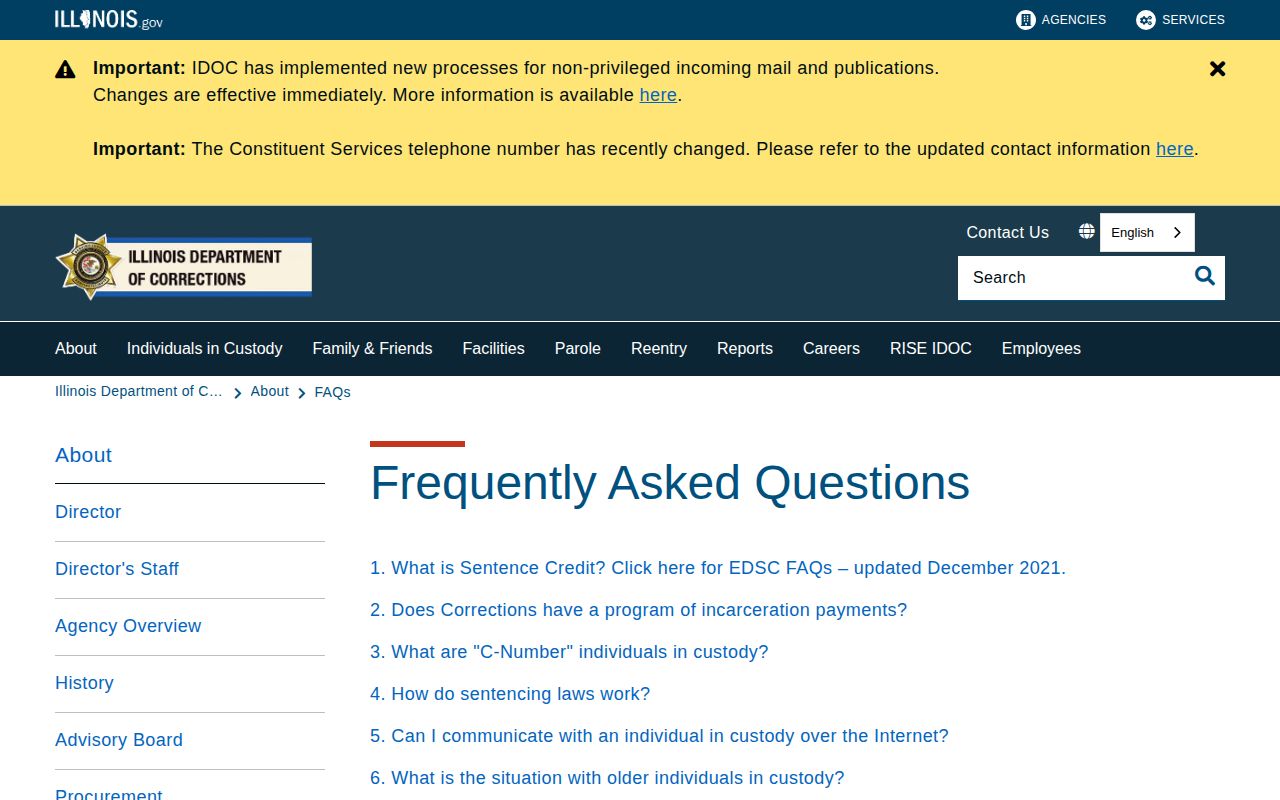
That limit makes an archived Record Search necessary when a completed Knox commitment no longer appears in the public locator.
Knox Sentence Credit Rules
Illinois sentence credit is governed by 730 ILCS 5/3-6-3. The rule is offense-specific and date-specific. Certain first-degree murder categories receive no sentence credit and require full service. Listed violent offenses generally permit no more than 4.5 days per month, often described as about 85 percent served. Listed serious drug and gunrunning categories generally permit no more than 7.5 days per month, often described as about 75 percent. Other qualifying offenses may receive one day of credit per day.
Those shorthand percentages are not calculators. The offense of conviction, offense date, statutory subsection, findings such as great bodily harm, consecutive or concurrent terms, jail credit, discipline, and the IDOC computation all matter. Earned program credit also has eligibility limits, caps, program requirements, revocation rules, and truth-in-sentencing floors.
The official sentence-credit text supplies the controlling categories.
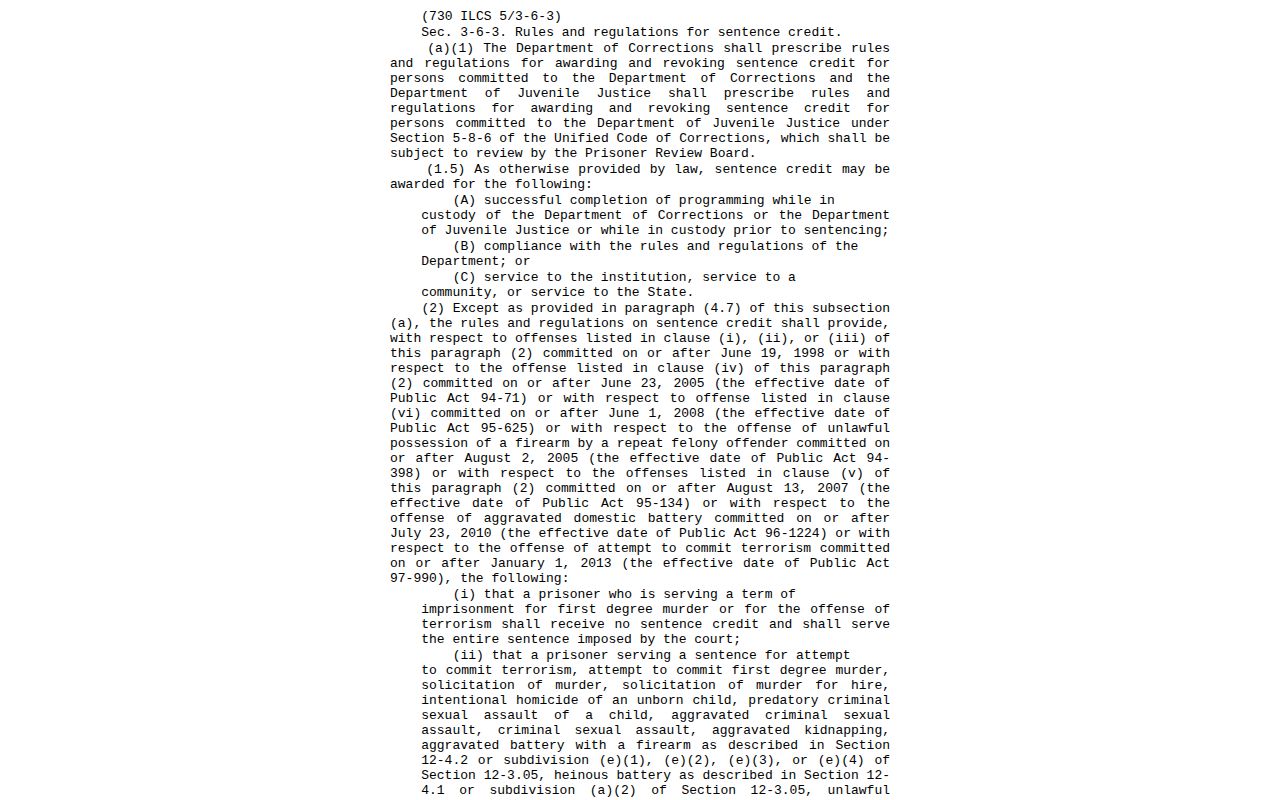
The statute must be paired with the judgment and IDOC calculation. Do not reverse-engineer an individual release date from a percentage alone.
Why Knox Release Dates Change
A projection can move for lawful and administrative reasons. Preserve both dated observations when a public field changes, then use the official computation or court record to explain the change.
| Change | Possible effect |
|---|---|
| Sentence or appellate order | Changes the term, count, or legal basis |
| Custody and earned credits | Adjust the calculation within statutory limits |
| Disciplinary credit loss | Can move a projection later |
| Consecutive sentences | Require terms to be served in sequence |
| Warrant or detainer | Can shift the person to another custodian at release |
| Revocation | Can return a released person to custody and create a new date |
A detainer is a request or legal basis for another agency to take custody. Illinois law at 730 ILCS 5/3-3-6 underscores that release to a warrant or detainer can be a transfer. It should never be described as an assured return to the community.
Knox County Jail Date Requests
Do not apply the IDOC credit formula to a county sentence. Knox County has not published a jail good-time formula, weekend policy, holiday rule, standard release hour, or processing timetable. Ask for the existing computation sheet and release ledger. The sheriff's 24-hour line is 309-343-9151; administration is 309-345-3733.
The court docket supplies the legal basis. Judici can show a release order, dismissal, sentence, time served, probation, or mittimus. The jail ledger supplies the processed exit and disposition. A court order may precede physical departure because staff must complete processing and check other holds.
- Mittimus
- A court order committing a person to a jail or prison.
- Custody credit
- Time already served that the court or custodian applies to a sentence.
- Detainer
- A hold or request from another authority that can lead to transfer.
- MSR
- Mandatory supervised release, the supervised period that commonly follows an Illinois prison term.
Note: Knox publishes no standard jail release hour, so a court date or sentence estimate should not be presented as a pickup time.
Legacy Knox Parole Projections
Most post-1978 determinate prisoners leave prison by operation of sentence law and enter MSR. The legacy IDOC label Projected Parole Date does not mean that every person awaits a discretionary parole vote. Illinois Prisoner Review Board hearings for indeterminate C-number cases chiefly concern older offenses, while youthful review is a distinct statutory exception.
730 ILCS 5/3-3-3 addresses legacy parole eligibility. Qualifying youthful review is governed by 730 ILCS 5/5-4.5-115, with offense, age, sentencing-date, and exclusion rules. Neither route should be inferred from a date label alone.
The youthful parole review statute shows why case-specific eligibility matters.
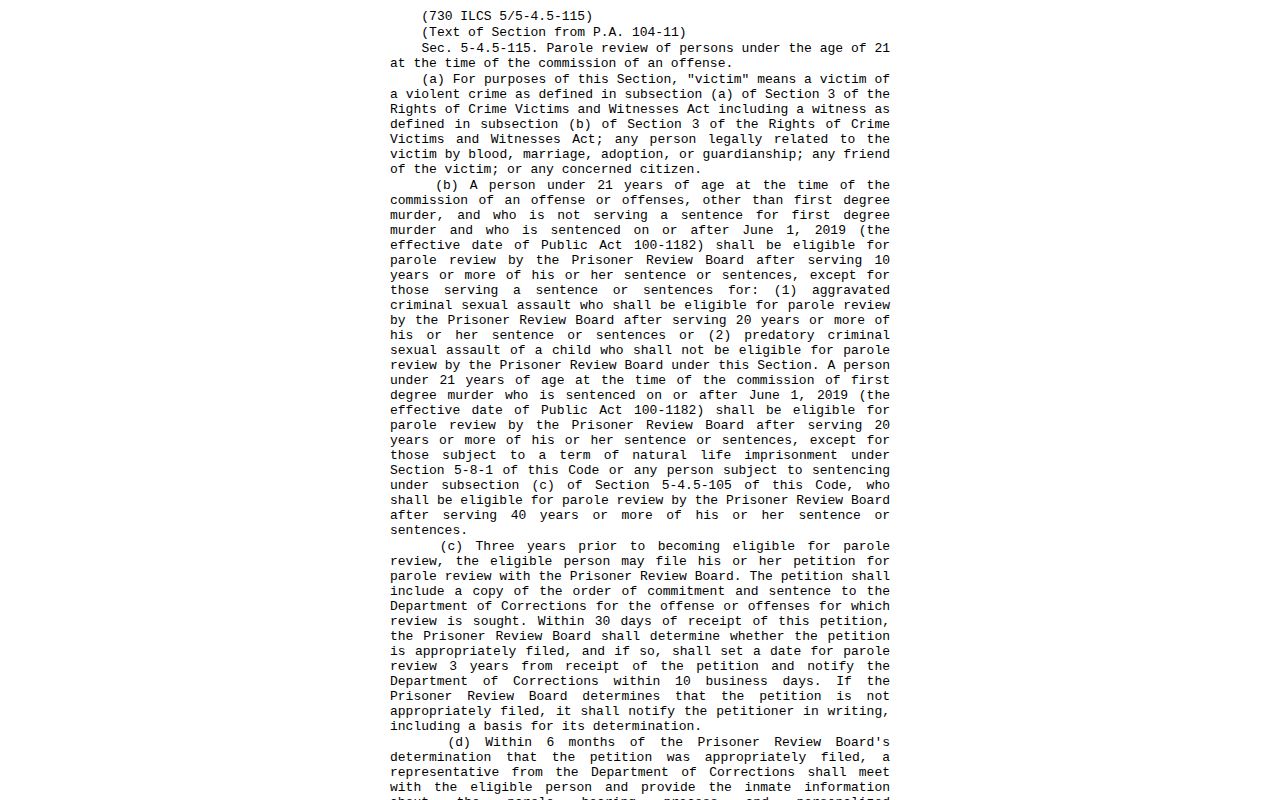
The statute supplies a review framework, not a promised release date. Actual release still requires the decision, current status, and custodian record.
For notice of a custody change rather than a calculated forecast, use the Knox County VINELink check and verify the event with the source.
Verify Knox Actual Release
If an IDOC projection disappears, do not treat the blank screen as proof of release. IDOC states that completed sentences stop displaying, while a recent county-to-state transfer may also take time to appear. Use Contact Us with the General Subject “Record Search” for older history. Supply the full name, birth date, IDOC number if known, approximate reception year, facility, conviction county, and dates sought.
A correction follows a different route. IDOC says certified committing-court records can support changes when state data does not reflect the court result. Preserve the questioned field, the date viewed, and the certified order. A web screenshot alone is not the authoritative correction document. For a Knox jail calculation, request the sheriff's own ledger and computation material rather than sending a county issue to IDOC.
The final check occurs after the forecasted day. Review Offender Status and Last Paroled Date, then obtain the release record if exact time or destination matters. Release to MSR means prison custody ended while state supervision continued. Release to a warrant or detainer means another custodian may have taken control. Only a supported destination should be described as return to the community.
Compare Knox Release Projections
A sound comparison preserves each projection with its observation date. Do not overwrite an older value when the state record changes. Two dated values can show that IDOC recalculated the term, but only the official computation, disciplinary record, or court order can establish why. Ask the responsible agency for that record instead of guessing from the size of the change.
County and state dates also use different endpoints. The Knox sheriff can close a booking when it transfers a sentenced person to IDOC. IDOC's Admission Date then begins the state episode. A later Projected Parole Date concerns prison exit, while Projected Discharge Date can extend through supervision. Treating all four dates as one release date erases the custody sequence.
Public Record Search
Sponsored Results