
Federal Knox Release Destinations
Federal contract custody is a system path, not a confirmed Knox County facility. USMS may place a federal pretrial prisoner in a local contract bed and move that person as court proceedings change. Research found no basis for describing Knox County Jail as a dedicated federal prison. Only a docket, detainer, charge, or sheriff disposition should trigger this workflow.
A Knox release record may say transfer to USMS. That closes the sheriff's custody episode but does not establish freedom in the community. The person may move to a contract facility, a federal detention center, BOP custody after sentence, or release under a federal court order. Preserve the word transfer until the receiving record or order supports a later release.
Confirm Federal Knox Releases
Begin with the federal case because the court order supplies legal authority. Then identify the agency that held or moved the person. BOP is not a catch-all search for every federal defendant.
- Obtain the Knox sheriff release or transfer disposition and note any USMS destination.
- Locate the matching federal criminal case and read detention, release, judgment, and commitment orders.
- Search BOP only when the person entered its custody.
- Compare register number, full name, age, race, sex, offense context, and dates.
- Request disposition material from USMS when public records do not resolve the movement.
The Knox County released-inmate record path explains how to obtain the sheriff timestamp that starts this chain.
Read Federal Release Results
The BOP inmate locator searches by register number or by name with age, race, and sex refinements. Results can show name, register number, age, race, sex, release date, and location. Strong identity matching is essential.
| BOP result | Meaning |
|---|---|
| RELEASED | No longer in BOP custody, not necessarily free of all custody or supervision |
| Past release date, no institution | A recorded BOP custody exit |
| Future release date | A projection that can change |
| IN TRANSIT | Movement within the federal custody system |
| UNKNOWN | The locator does not provide a current institution |
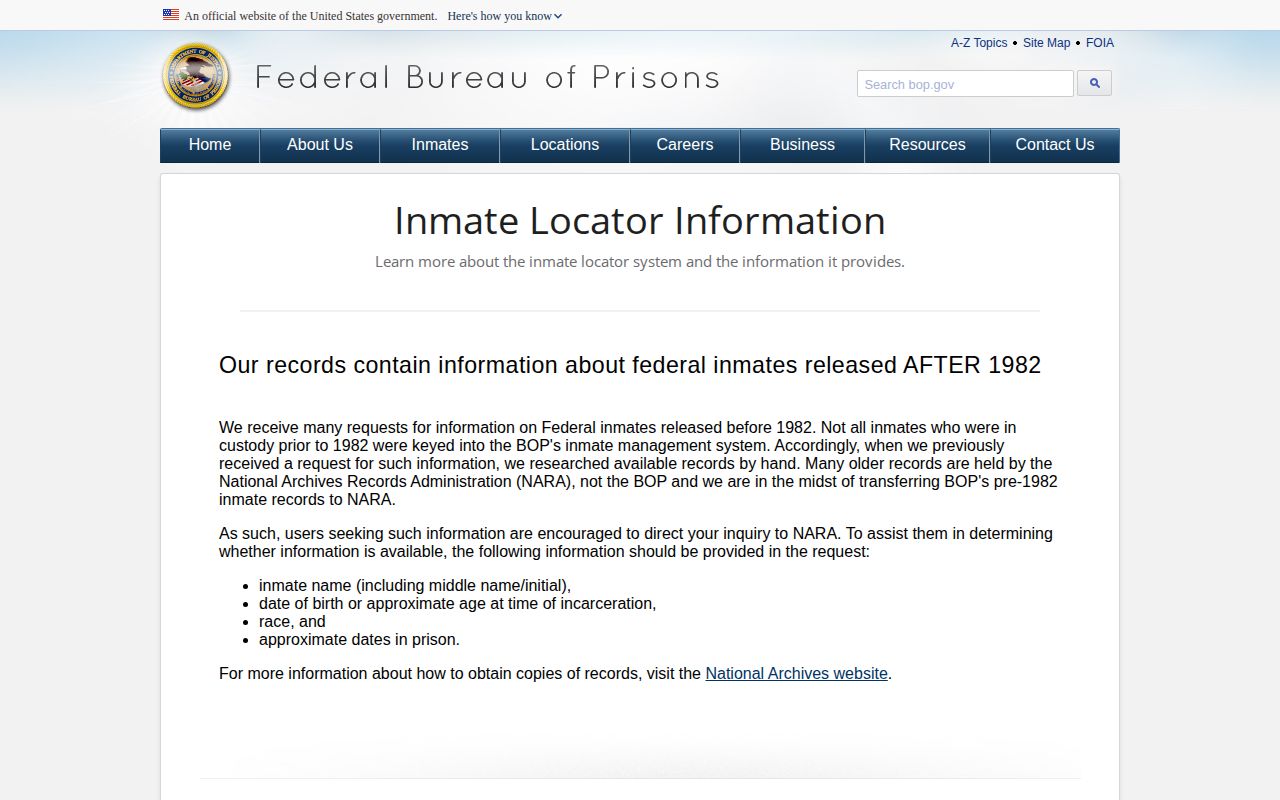
BOP extracts locator data daily and generally covers federal inmates from 1982 forward. Older records may require the National Archives. A blank result may mean no BOP episode, older history, mismatched identity, or federal pretrial custody that never entered BOP.
The BOP locator field guide explains the RELEASED label and its limits.
The federal label confirms only the end of BOP custody. Supervised release or another agency's custody can continue afterward.
USMS Knox Release Records
The U.S. Marshals Service has no public general locator for released prisoners. Its Prisoner Tracking System supports processing, housing, safekeeping, and disposition of federal prisoners pending proceedings. That internal role explains why a person under Marshals control may not appear in the BOP locator.
Use the federal docket for the detention or release order. Use USMS FOIA for releasable historical disposition material. Frame the request around an existing record: full identity, federal case number, approximate custody dates, originating district, contract facility if known, and the movement or disposition sought. Do not ask Knox County to produce the whole federal file.
A county request can still establish the local transfer timestamp and destination recorded by the sheriff. The USMS record then addresses federal movement. The two records should be kept distinct, even when their dates are close.
Federal Custody Records Contact
There is no verified federal release desk or federal prison address in Knox County to publish. Contacts depend on the record holder. This avoids sending a caller to a local building that does not maintain the requested federal information.
Bureau of Prisons: Inmate Locator
U.S. Marshals Service: FOIA request route
Federal court: detention, release, judgment, and supervised-release orders
Knox County Sheriff: 309-343-9151 for the county custody endpoint
A federal supervised-release term is imposed and overseen through the federal court system after custody. It is not Illinois parole or mandatory supervised release. The judgment and probation-office process supply that context.
Resolve Federal Release Conflicts
Official records can appear to conflict because they describe different events. A court release order is legal authority. USMS controls the physical movement it carries out. BOP records entry and exit from its own custody. The Knox sheriff ledger records when local custody ended. Those events can occur on different dates without any source being wrong.
- Detention order
- A federal court order requiring custody while proceedings continue.
- Release order
- A court order authorizing release under stated terms.
- Contract custody
- Placement in a non-BOP facility used by a federal custodian.
- Supervised release
- A federal court status after imprisonment, distinct from Illinois parole or MSR.
When a BOP date is future, call it projected. First Step Act credit recalculation and other official changes can move it. When BOP says RELEASED, say released from BOP custody unless another record proves the destination. When Knox says released to USMS, say transferred to USMS.
Note: A federal court release order may precede physical movement, so retain the order and the custodian's dated exit record.
Federal and ICE Differences
Federal criminal custody and civil immigration detention are not interchangeable. BOP and USMS handle federal criminal custody paths. ICE ODLS covers many current immigration detainees and recent releases from ICE custody. A federal criminal case does not automatically create an ICE record, and an immigration detainer does not prove BOP custody.
If the Knox disposition expressly names ICE, follow the ICE custody locator route. If it names USMS, start with the federal docket and Marshals records. A vague roster disappearance justifies neither assumption.
The best final statement stays bounded to the evidence: Knox County custody ended at the sheriff's recorded time; federal custody began if the receiving record shows it; BOP custody ended on the recorded date if the locator or archived record confirms it. This sequence protects the distinction between transfer and return to the community.
Archive Federal Knox Releases
For older BOP history, the locator's general 1982 starting point matters. Use the National Archives route when the federal episode predates that coverage. For a recent result, note that BOP extracts data daily, so a court order and locator update may not appear at the same moment. A dated observation is more useful than an undated screenshot.
Public Record Search
Sponsored Results