
Municipal Holding Releases in Knox
Municipal police temporary holding is short-term custody associated with an arresting department. It is not the same as a county jail sentence, IDOC prison term, federal detention, or ICE custody. Research found no separate municipal long-term jail in Knox County and no municipal portal listing released people. That boundary prevents a common error: searching the Knox County Jail app for a person who was never booked there.
A person may be released by the police department under the authority applicable to the event, or may be moved to the Knox County Jail for booking. The record holder changes with that choice. When police release occurs before county booking, request the arrest, custody, and release fields from the arresting department and check the matching court record. When the jail accepts the person, use the sheriff release ledger for the end of county custody.
Confirm a Municipal Holding Release
Start with the agency name on the arrest record, citation, property receipt, or court docket. Do not assume Galesburg Police handled every municipal event in Knox County. Once the arresting department is known, use a narrow sequence that distinguishes an oral status check from a dated record.
- Contact the arresting police department and ask whether it kept the person temporarily, released the person, or transferred the person to Knox County Jail.
- Request existing records that show custody start, release or transfer date and time, the recorded manner, and the receiving agency if one is listed.
- Search the Knox court case through Judici and match the name, case number, date, and charge carefully.
- If county booking occurred, check the sheriff app and contact the jail. The municipal record then establishes transfer, while the sheriff record covers the later episode.
- If a receiving state or federal agency is named, verify that next custody episode with the matching official source.
The Knox County release search and records workflow explains how to reconcile those systems for one named person. Preserve the date and exact wording of each response. Different sources can be correct because they describe different stages.
Galesburg Police Records Route
Galesburg is the county seat and the location of the Knox County Law Enforcement Center, but the Galesburg Police Department and Knox County Sheriff remain different agencies. The Galesburg Police records page is the correct starting route when a Galesburg officer handled a temporary custody event that never became a county jail booking.
The official records page shown below supports that municipal request path. It does not prove a particular person was released, and it is not a released-person list.
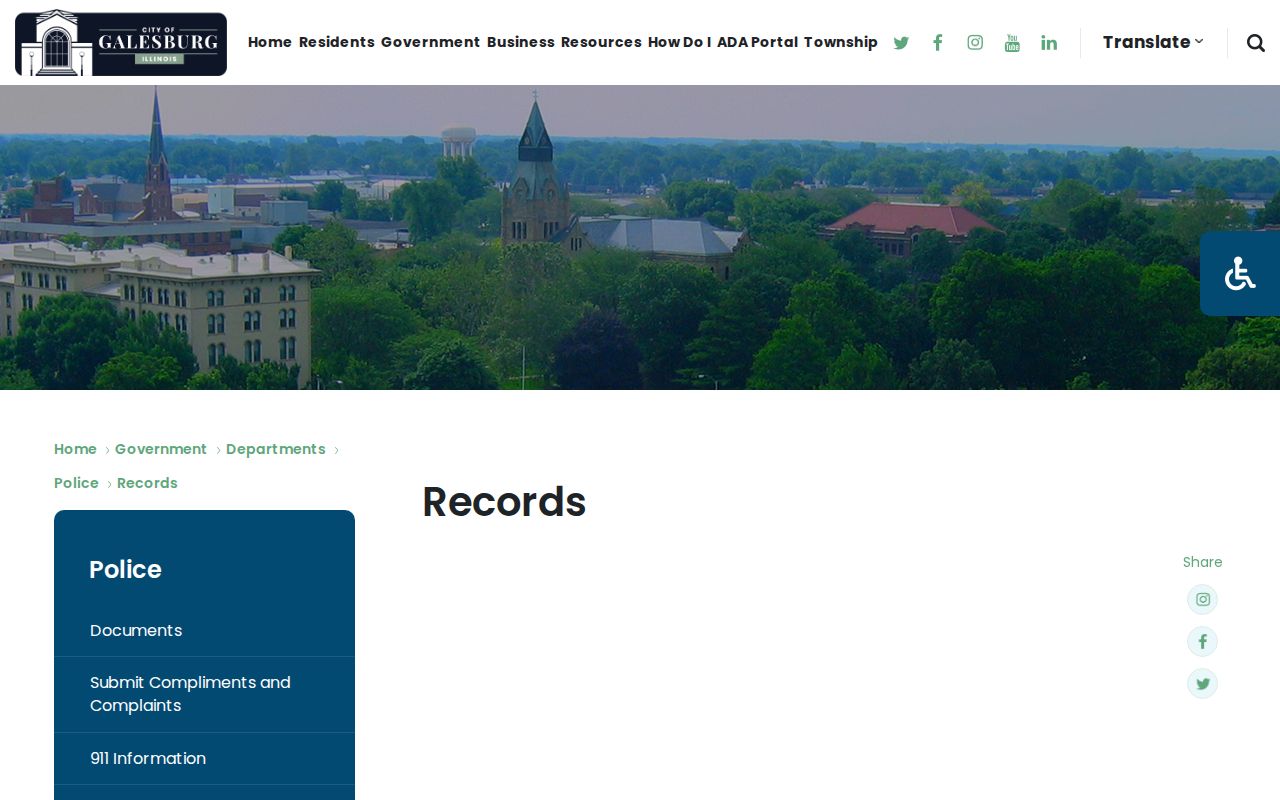
Use the department's current instructions and provide enough stable detail to identify the event. A full name, date of birth when appropriate, incident number, arrest date, and narrow time range help prevent a common-name mismatch.
Note: The municipal records route applies only when that police department created or maintains the requested custody record.
Municipal Release Record Fields
A focused request should seek records, not ask staff to draw legal conclusions. The exact fields depend on the department's system and lawful redactions. The table identifies useful fields to request without claiming that every agency maintains each one in the same format.
| Field | Why it matters |
|---|---|
| Incident or arrest number | Identifies the municipal event and avoids merging it with a county booking. |
| Custody start | Shows when the police holding episode began. |
| Release or transfer timestamp | Records when municipal custody ended. |
| Release manner or authority | May connect the exit to a citation, court authority, or other recorded basis. |
| Receiving agency | Shows whether Knox County Jail or another custodian took over. |
| Case reference | Links the event to the correct court docket when one exists. |
A transfer timestamp is not a community release. If Knox County Jail is named, confirm its booking and later release separately. If no receiving agency appears, describe only what the municipal record supports.
Knox Jail Booking After Holding
The active county jail is in the Knox County Law Enforcement Center at 152 S. Kellogg St. in Galesburg. It is operated by the Knox County Sheriff. If police transport a person there and the jail accepts the booking, the sheriff becomes the source for the booking number, jail custody status, and end-of-custody record.
The official sheriff website sends roster users to its mobile app and does not publish a browser release archive. Call the jail's 24-hour line at 309-343-9151 for a narrow current-status question. For historical release time, manner, or destination, send a focused request to the Sheriff's own FOIA channel. The county's general FOIA directions say the Sheriff and Circuit Clerk handle their own requests.
- Municipal holding
- Short-term custody controlled by the arresting police department.
- County booking
- Acceptance into the Knox County Jail's jail-management record.
- Transfer
- The end of one agency's custody followed by a receiving custodian.
- Release
- The reporting agency ended its custody, with destination determined from the record.
Knox Court Release Context
The court record and custody record serve different roles. A docket can show a pretrial order, dismissal, sentence, time served, probation, conditional discharge, or mittimus. The custodian's record supplies the physical processing timestamp. A court order may precede the actual exit, and a dismissal in one case does not resolve another warrant or hold.
The Knox County Courthouse is at 200 S. Cherry St., Galesburg, Illinois 61401. The Illinois Courts directory lists the courthouse and public contact route. Use the full case number when requesting an order. Ask the Circuit Clerk for the specific docket, release, detention, dismissal, sentencing, or transfer document rather than requesting an undefined file.
Sealed, expunged, juvenile, impounded, or otherwise confidential records will not appear like an ordinary public criminal case. A blank docket therefore does not prove that no municipal custody episode occurred.
Galesburg Police Custody Checks
The Galesburg Police Department page provides the official department route for a present municipal-custody question. The page image below identifies the agency source, not a holding-facility locator.

Ask a precise question and note the office, date, time, and answer. If staff say the person went to the county jail, switch to the sheriff path. If staff say the person was released by the department, request the dated municipal record for historical proof.
Note: No public name-based municipal release database was identified, so a blank county app search cannot fill this local gap.
Other Custody After Municipal Release
IDOC, BOP, USMS, and ICE are conditional paths. They should be used only when a court order, transfer entry, detainer, charge, or receiving-agency field supplies a reason. A person does not become an IDOC or federal record merely because municipal or county custody ended.
If the court commits the person to IDOC, the IDOC Admission Date and Offender Status can confirm the new state episode after processing. For federal pretrial custody, the federal docket and USMS are more useful than BOP unless the person actually enters BOP custody. An ICE transfer is agency-to-agency movement, not proof of return to the community. No official evidence identified Knox County Jail as an ICE detention facility.
Illinois VINE may provide a custody notification for a participating record, but a blank result proves neither release nor nonparticipation. Confirm the event with the source agency. This keeps each conclusion within the system that created it.
Municipal Records and Illinois FOIA
Illinois FOIA, 5 ILCS 140, governs executive-agency public-record requests subject to exemptions and redactions. A request should identify the police department, person or incident, narrow date range, and desired existing fields. Ask for electronic copies and segregable nonexempt portions. If a code is used, ask for its data dictionary or legend.
A noncommercial request is generally due within five business days, though the public body may invoke a written statutory extension. A written denial should cite its basis. Court records can follow court-access rules and the clerk's procedure rather than the same executive-agency route. Send each request to the office that maintains the record.
Public Record Search
Sponsored Results